OnlineOrNot updates from January 2026

Max Rozen / Published: February 04, 2026
Hopefully this will be one of the last major "behind-the-scenes" updates for a while, because OnlineOrNot's frontend now runs on a React framework that's easy to deploy across multiple providers, and is fully off GraphQL, being powered by its own REST API.
Table of contents
What's new
Features for the platform
Expanded REST API
As of today, you can manage almost everything in OnlineOrNot programmatically:
- Heartbeat checks - create, list, update, pause, mute, and delete heartbeat checks
- Maintenance windows - create, update, list, and delete maintenance windows
- Status page incidents - create and manage incidents and incident updates, including per-component status changes
- Scheduled maintenance - schedule, update, and cancel maintenance events on your status pages
- Status page subscribers - manage email subscribers for your status pages
- Status page components - add, reorder, and remove components
- Team management - invite, list, and remove team members
As I mentioned earlier, the OnlineOrNot dashboard itself has been rewritten to use the same REST API instead of GraphQL, so the API is a first-class citizen that can't go out of date or become unmaintained. As a side-effect, we get a faster and more reliable dashboard.
Every new endpoint follows the same conventions as the existing API, with consistent error responses and OpenAPI documentation.
Features for Checks
Per-region response time breakdown
You know your API is slow, but is it slow everywhere, or just from one region? Maybe it's a database replica lagging in Europe, or a CDN cache miss in Asia-Pacific.
OnlineOrNot used to average response times across all monitoring regions into a single number, which made it hard to tell at a glance.
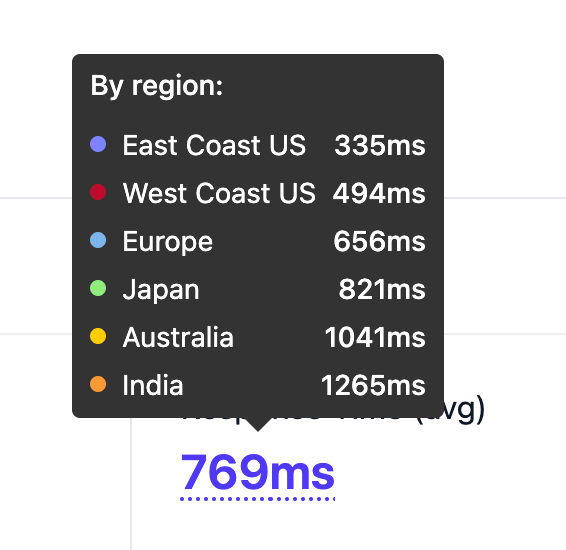
Your uptime check detail pages now show a per-region breakdown of response times, so you can see exactly where things are slow and narrow down the cause faster.
Features for Status Pages
They're even faster now
When your service goes down, the last thing you want is for your status page to be slow to load too. Your customers are already stressed, and a sluggish status page doesn't help.
I've spent some time optimizing how OnlineOrNot's public status pages are served. Behind the scenes, status pages now run with targeted placement to minimise round-trip time, lazy loading has been replaced with optimized server-side queries, and the overall page weight has been reduced.
The result: your status page loads faster, and incidents display more quickly during the moments that matter most.
Incident improvements
Speaking of incidents: after an incident gets resolved, one of the first things your customers want to know is "how long was it down?"
Previously, they'd have to do the mental math themselves by comparing timestamps.
Resolved incidents on your status pages now display how long they took to resolve (e.g., "Resolved after 7 minutes"), so your customers can see the impact at a glance.
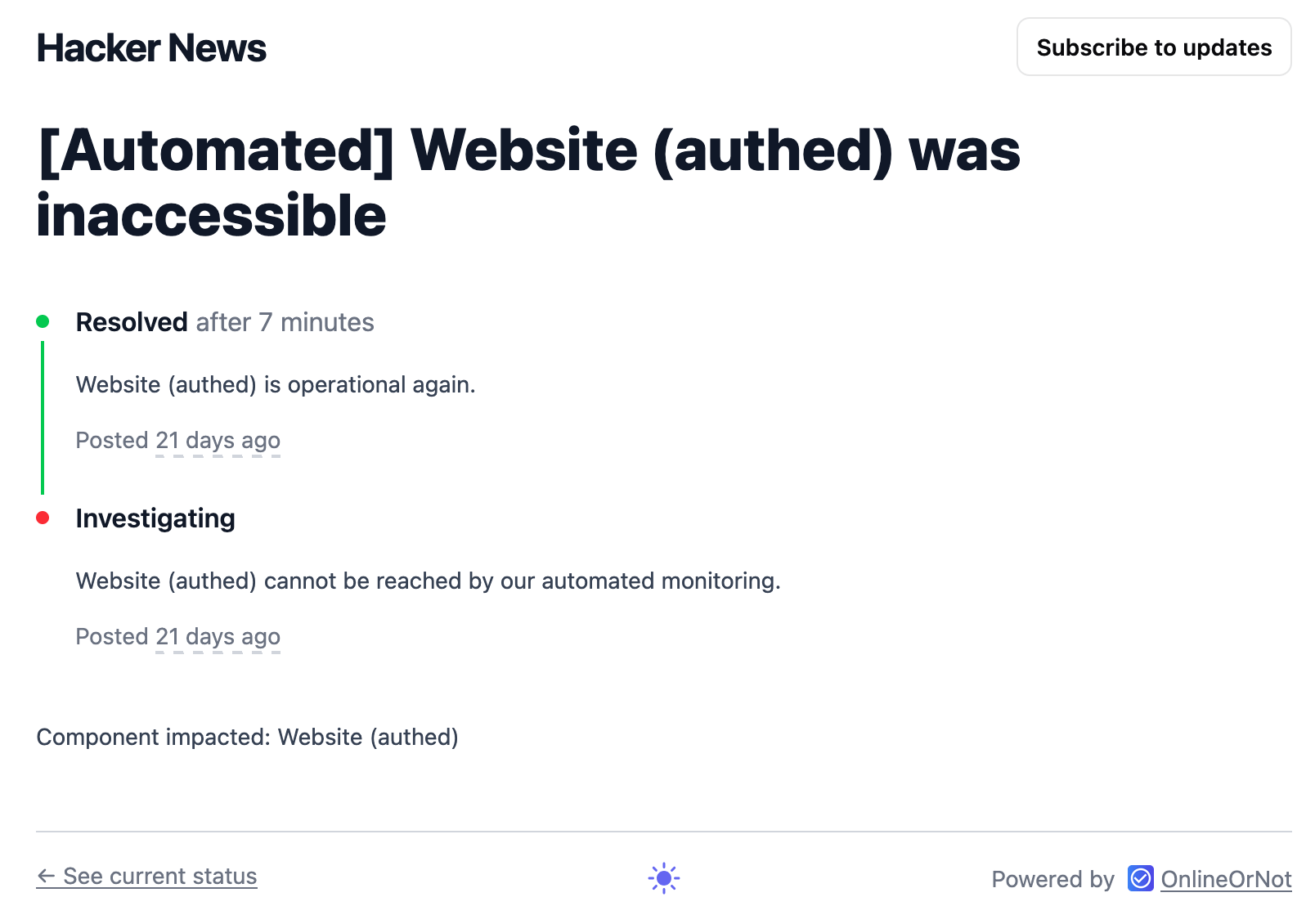
I've also added incident timelines to the recent incidents section of your status page. Your customers can now see the full progression of an incident without having to click into each one individually.